Jean Rhys’s Postcolonial Feminist Response to Brontë’s Jane Eyre
DOI:
https://doi.org/10.5281/zenodo.23131872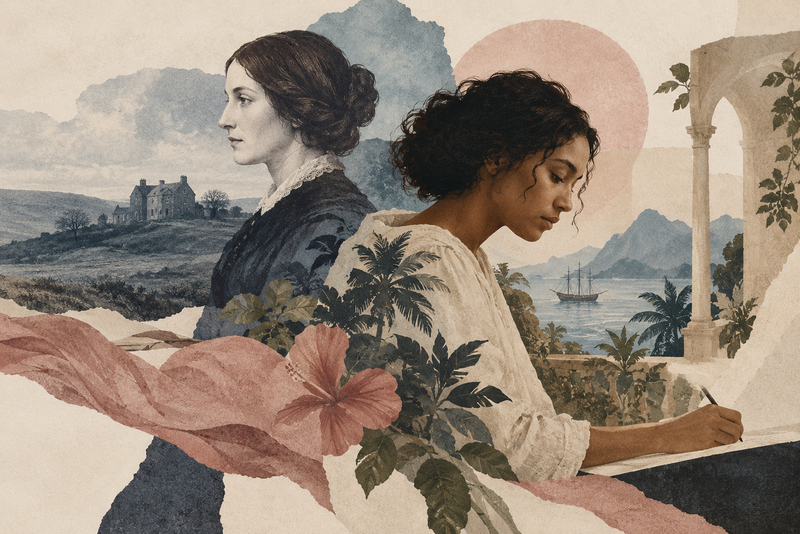
Abstract
This article investigates Jean Rhys’s Wide Sargasso Sea as a postcolonial feminist rewriting of Charlotte Brontë’s Jane Eyre. The study explores that Rhys transforms Bertha Mason, a silenced and racialized figure in Brontë’s novel, into Antoinette Cosway, a complex Creole subject whose history, voice, and displacement expose the connections between patriarchy, colonialism, race, and economic power. Drawing on Gayatri Chakravorty Spivak’s critique of imperialism, Homi K. Bhabha’s theory of hybridity, and feminist and postcolonial scholarship, the study analyzes Antoinette’s unstable identity, Rochester’s patriarchal authority, the politics of naming, marriage and confinement, and the representation of madness. Rhys’s narrative technique of giving the marginalized woman a voice while simultaneously raising the question of whether a subaltern voice can be fully recovered is given special attention. The destruction of Thornfield is further interpreted in the article as a vague act of resistance. It comes to the conclusion that Rhys's book challenges the colonial and patriarchal presumptions that enabled Brontë's portrayal of Bertha in the first place rather than merely correcting it.
Keywords:
Jean Rhys Wide Sargasso Sea Jane Eyre postcolonial feminism Bertha Mason Antoinette Cosway colonialism gender madnessReferences
Awan, A. G., & Khan, T. A. (2025). Subaltern echoes in the White Creole: A postcolonial feminist study of Jean Rhys’s Wide Sargasso Sea. Southern Journal of Arts & Humanities.
Bhabha, H. K. (1994). The location of culture. Routledge.
Brontë, C. (1847). Jane Eyre. Smith, Elder & Co.
Funck, S. B. (2012). Of mimicry and woman: A feminist postcolonial reading of Wide Sargasso Sea and The Biggest Modern Woman of the World. Revista Estudos Anglo-Americanos.
Gogoi, S. (2025). There is always ‘the other side’: Gender, race, ethnicity, and colonial madness in Jean Rhys’ Wide Sargasso Sea through postcolonial and postcolonial feminist theory. Dibon Journal of Languages.
Ionoaia, E. (2008). The creolization of the self: From Jane Eyre to Wide Sargasso Sea. University of Bucharest Review, 10(2), 137–143.
Mardorossian, C. M. (1999). Shutting up the subaltern: Silences, stereotypes, and double-entendre in Jean Rhys’s Wide Sargasso Sea. Callaloo, 22(4), 1071–1090.
Rhys, J. (1966). Wide Sargasso Sea. André Deutsch.
Spivak, G. C. (1985). Three women’s texts and a critique of imperialism. Critical Inquiry, 12(1), 243–261.
Spivak, G. C. (1988). Can the subaltern speak? In C. Nelson & L. Grossberg (Eds.), Marxism and the interpretation of culture. University of Illinois Press.
Published
Downloads
How to Cite
Issue
Section
License
Copyright (c) 2026 Gulasal Zoxidjon qizi Borijonova

This work is licensed under a Creative Commons Attribution 4.0 International License.


 Republic of Uzbekistan, Tashkent city,
  +998 93 097 75 88