Author – text – director – viewer: reception models and meaning-making strategies in the film discourse of little women
DOI:
https://doi.org/10.5281/zenodo.23132390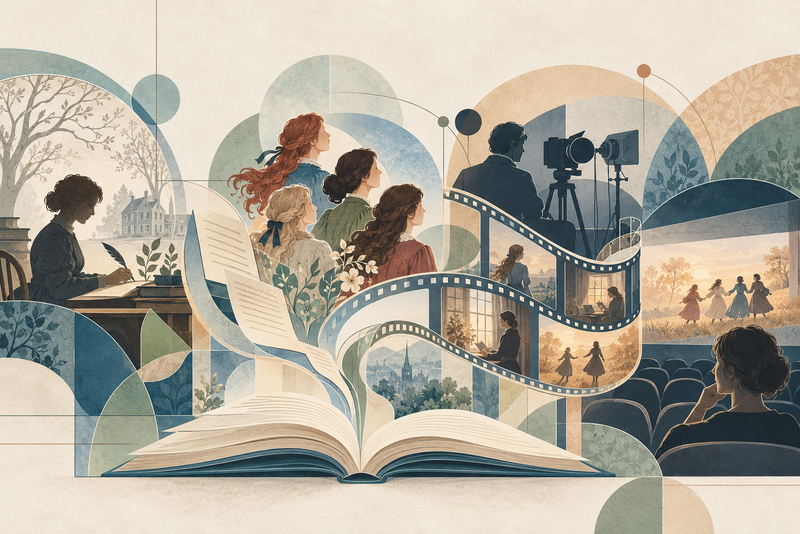
Abstract
Traditional adaptation theory treats the film director as a relatively neutral mediator who transfers literary meaning onto the screen, which simplifies the actual communicative structure of the act of adaptation. The article proposes an extended four-part communicative model of film discourse – “author – text – director – viewer” – combining the narratological category of the implied author with the reception-aesthetic categories of the horizon of expectation and the implied reader/viewer. The director is treated as an independent communicative instance, a “reading author” who simultaneously occupies the position of a real reader of the literary source and the creator of a new implied author of the film text, who in turn constructs an implied viewer. The model is tested on four English-language film adaptations of L.M. Alcott's novel Little Women (1933, 1949, 1994, 2019). Based on comparative analysis, a typology of directorial meaning-making strategies is proposed – reproductive, decorative-escapist, actualizing and metafictional – reflecting a consistent increase in reflexive distance between the source text and the film text over nearly a century. The findings provide deeper insight into the role of directorial interpretation in transforming literary narratives and demonstrate how historical and cultural contexts shape meaning-making strategies, audience reception, and film adaptation
Keywords:
Reception aesthetics implied author implied reader implied viewer film discourse meaning-making Little Women film adaptationReferences
Alcott, L. M. (1869). Little women. Roberts Brothers.
Booth, W. (1961). The rhetoric of fiction. University of Chicago Press.
Bordwell, D. (1985). Narration in the fiction film. University of Wisconsin Press.
Chatman, S. (1978). Story and discourse: Narrative structure in fiction and film. Cornell University Press.
Hutcheon, L. (2013). A theory of adaptation (2nd ed.). Routledge.
Изер, В. (2004). Аппелятивная структура текста. В: И. В. Кабанова (сост.), Современная литературная теория: антология. 197–223. Флинта: Наука.
Яусс, Х. Р. (1995). История литературы как провокация литературоведческой науки. Новое литературное обозрение, 12, 34–84.
Published
Downloads
How to Cite
Issue
Section
License
Copyright (c) 2026 Oynur Tohirjon qizi Dzharkinova

This work is licensed under a Creative Commons Attribution 4.0 International License.


 Republic of Uzbekistan, Tashkent city,
  +998 93 097 75 88