Psychological and pedagogical characteristics of communication in students with autism spectrum disorder
DOI:
https://doi.org/10.5281/zenodo.23877487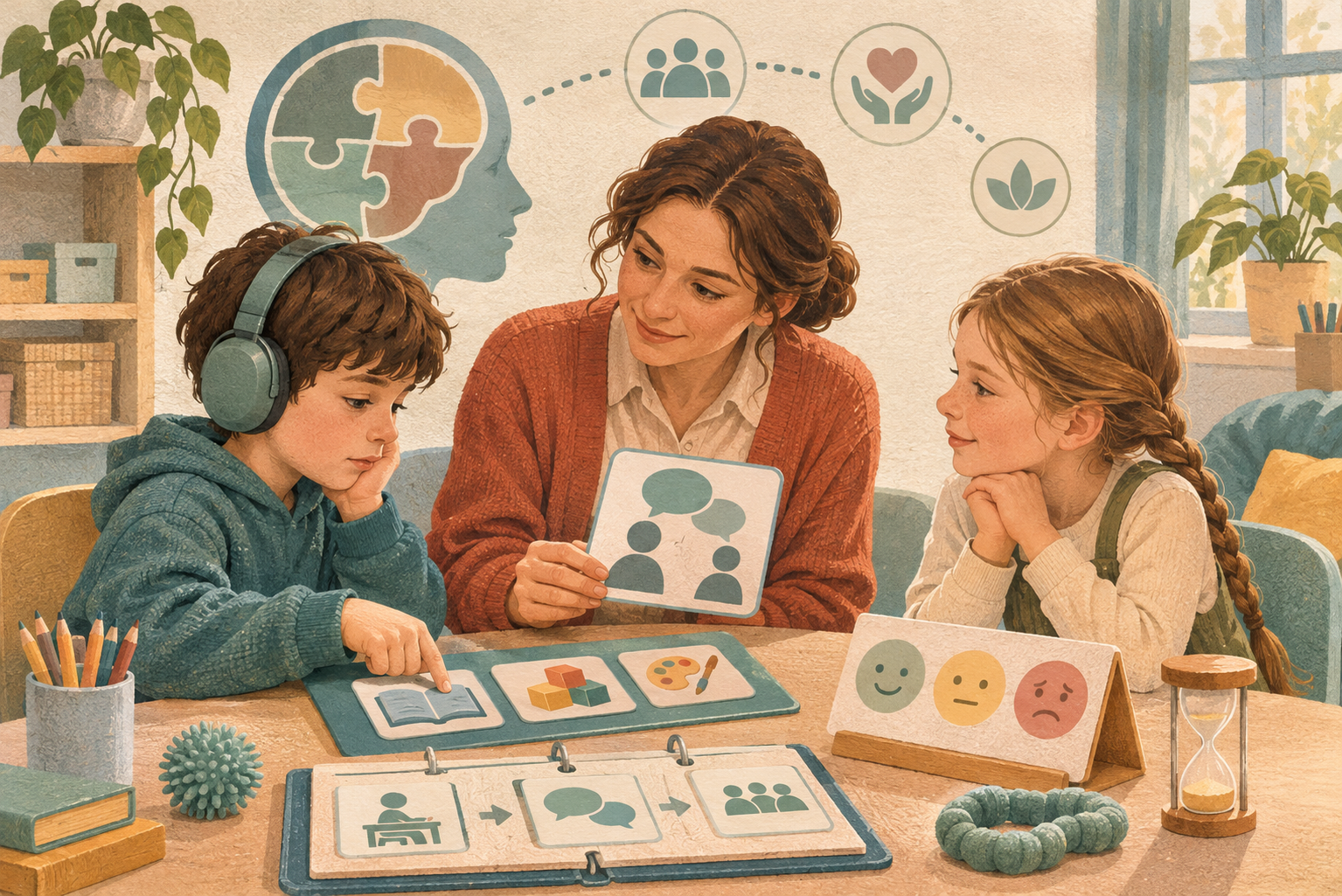
Abstract
This article examines the psychological and pedagogical characteristics of communication among students with autism spectrum disorder through a critical analysis of research. It aims to identify individual differences in communication, the influence of classroom conditions, and educational support. The study adopts a targeted narrative review of publications from 2022 to 2026, including systematic reviews, meta-analyses, and school-based studies. The analysis addresses spoken and nonspoken communication, pragmatic interaction, emotional regulation, sensory experiences, peer relationships, and augmentative and alternative communication. Findings indicate that successful communication depends not only on student abilities but also on communication partners, task organization, and accessibility. Peer-mediated approaches and visual or electronic supports offer options, although effects vary across learners and settings. The paper proposes an individualized educational framework prioritizing communicative initiative, student preferences, and functional participation. Particular attention is given to distinguishing the performance of prescribed social behaviors from meaningful, reciprocal engagement in classroom activities and relationships.
Keywords:
autism spectrum disorder social communication inclusive education pragmatics peer interaction augmentative communication sensory environment individualized supportReferences
Afsharnejad, B., Whitehorne Smith, P., Bölte, S., Milbourn, B., & Girdler, S. (2026). A systematic review of implicit versus explicit social skills group programs in different settings for school-aged autistic children and adolescents. Journal of Autism and Developmental Disorders, 56(5), 1707–1724. https://doi.org/10.1007/s10803-024-06657-z
Atkinson, E., Wood-Downie, H., & Wright, S. (2024). ‘Everybody needs to learn more’: A thematic synthesis of the first-hand experiences of autistic students in primary schools. Neurodiversity, 2. https://doi.org/10.1177/27546330241275160
Edgar, T. C., Schlosser, R. W., & Koul, R. (2024). Effects of an augmentative and alternative communication intervention package on socio-communicative behaviors between minimally speaking autistic children and their peers. American Journal of Speech-Language Pathology, 33(4), 1619–1638. https://doi.org/10.1044/2024_AJSLP-23-00313
McKinlay, M., Thorpe, D., Cage, E., Grainger, C., Jasper, C., & Stewart, M. (2025). A systematic review: Which psycho-social-environmental factors do autistic students identify as being important for positive experiences in mainstream secondary school? Autism, 29(3), 566–578. https://doi.org/10.1177/13623613241285974
Nejati, V., Peyvandi, A., Nazari, N., & Abadi, F. (2024). The effectiveness of social training in individuals with autism spectrum disorder (ASD): A systematic review and transfer analysis. Scientific Reports, 14, Article 32131. https://doi.org/10.1038/s41598-024-83953-9
Perrelet, V., Veyre, A., Chawki, L., Margot, C., & Cappe, É. (2025). What are we targeting when we support inclusive education for autistic students? A systematic review of 233 empirical studies and call for community partnerships. Autism, 29(12), 2927–2940. https://doi.org/10.1177/13623613251352223
Pope, L., Light, J., & Laubscher, E. (2025). The effect of naturalistic developmental behavioral interventions and aided AAC on the language development of children on the autism spectrum with minimal speech: A systematic review and meta-analysis. Journal of Autism and Developmental Disorders, 55(9), 3078–3099. https://doi.org/10.1007/s10803-024-06382-7
Ragaglia, B., Trovato, I., & Bulgarelli, D. (2026). Peer-mediated social skills interventions in primary school settings for autistic children in the light of the ICF bio-psycho-social model: A systematic review. Journal of Autism and Developmental Disorders, 56(3), 1074–1097. https://doi.org/10.1007/s10803-024-06604-y
Tsamitrou, S., & Plumet, M.-H. (2024). The importance and challenges of observing social interactions in autistic preschoolers during inclusive educational settings: A scoping review. Autism & Developmental Language Impairments, 9. https://doi.org/10.1177/23969415241227077
Tsou, Y.-T., Kovács, L. V., Louloumari, A., Stockmann, L., Blijd-Hoogewys, E. M. A., Koutamanis, A., & Rieffe, C. (2026). School-based interventions for increasing autistic pupils’ social inclusion in mainstream schools: A systematic review. Review Journal of Autism and Developmental Disorders, 13, 45–68. https://doi.org/10.1007/s40489-024-00429-2
Walton, K. M., Borowy, A. R., & Taylor, C. A. (2024). “It just depends”: Parent, teacher, and expert conceptualization of social communication in young autistic children. Autism, 28(4), 920–931. https://doi.org/10.1177/13623613231185401
World Health Organization. (2025, September 17). Autism. https://www.who.int/news-room/fact-sheets/detail/autism-spectrum-disorders
Yi, J., Kim, W., & Lee, J. (2022). Effectiveness of the SCERTS model–based interventions for autistic children: A systematic review. Journal of Speech, Language, and Hearing Research, 65(7), 2662–2676. https://doi.org/10.1044/2022_JSLHR-21-00518
O‘zbekiston Respublikasi Prezidenti. (2020, 13 oktabr). Alohida ta’lim ehtiyojlari bo‘lgan bolalarga ta’lim-tarbiya berish tizimini yanada takomillashtirish chora-tadbirlari to‘g‘risida (PQ-4860-son qaror). https://lex.uz/uz/acts/5044711
Published
Downloads
How to Cite
Issue
Section
License
Copyright (c) 2026 Sayera Ataxanova

This work is licensed under a Creative Commons Attribution 4.0 International License.


 Republic of Uzbekistan, Tashkent city,
 +998 93 097 75 88