ALEXANDRA RUSSIAN-MUSLIM WOMEN’S SCHOOL – AS THE FIRST SECULAR WOMEN SCHOOL IN AZERBAIJAN
Abstract
In order to establish the intellectual and successful society the women of this society should be educated. Throughout the history Azerbaijani woman had an important role in the family and society, as well as in the establishment of moral and spiritual values of our nation with their power of will, bravery, purity and reliability. For a very long period the education of women was one of the critical problems in our country and starting from 19th century the intellectuals of Azerbaijan tried to solve these problems in different ways. This article gives information about the intellectual movements on women education which took place in Azerbaijan at the end of 19th and beginning of 20th centuries. The focus has been made on different women schools, courses and communities established during this period and their influence to the development of education in the country.
Throughout the history, women have had only a limited role in society with restricted opportunities. Women, on an equal basis as their male counterparts, must be the part of essential human resource base of each country that contributes to its competitiveness and sustainable development.
Whether in developed or developing countries, in urban or in rural lifestyles, ultimately an educated woman serves for the better and more equal society, with a ripple effect which positively impacts the future.
Women do bear responsibility for the boys and girls of tomorrow’s society, for their education and for instilling the values of equal treatment in and outside of home.
Keywords:
women`s education enlightener women literacy rate girls school women`s rights Islamic valuesThe great Azerbaijani philanthropist and industrial magnate Haji ZeynalabdinTaghiyev said: “The nation whose mother is illiterate is blind!”
Throughout history, women have had only a limited role in society with restricted opportunities. Women, on an equal basis as their male counterparts, must be the part of essential human resource base of each country that contributes to its competitiveness and sustainable development.
Whether in developed or developing countries, in urban or in rural lifestyles, ultimately an educated woman serves for the better and more equal society, with a ripple effect which positively impacts the future.
Women do bear responsibility for the boys and girls of tomorrow’s society, for their education and for instilling the values of equal treatment in and outside of home. There are still a lot of countries where access to education for women is limited to inferior curricula, rooted in gender stereotypes.
Women’s education has assumed special significance in the context of the country’s planned development. An educated woman is the best way to improve the country. This is because women represent a valuable human resource and play an important role in the development of community and nation. Wasting women's intellectual potential restricts the scientific development and technical progress in the country. In this context, it can be argued that lack of women’s education can be an impediment to the country’s economic development.
Literate, educated women have both a rich vocabulary and a wide range of vision. They are able to take more confident steps in life. They get marriage on the basis of love, wish and wisdom. Therefore these families have a solid foundation and future.
Azerbaijani women who had a great role in social and political, scientific, literary and art, humanitarian and other fields, passed hundred years long development way in a very short time in 20th century and their positions in society, social life, family were changed fundamentally. Women’s emancipation, reducing of women’s ignorance, as well as getting the equal rights with the men in the society were the main achievements of that period.
Most reformers, including secular nationalists, social democrats, and Muslim modernists, saw the emancipation of women as a prerequisite for the revival of Muslim civilization and Azerbaijan's economic, social, and cultural development. People in intellectual circles, especially writers like Mirza-Jalil Mammed-Quluzadeh (1861-1932) and his wife, Hamideh Javanshir (1873-1955) raised women's issues in their popular and influential journal Molla Nasreddin (1906-1930). Through powerful satire and cartoons, the journal played a crucial role in criticizing the government, corrupt officials, and religious conservatives as well as denouncing compulsory veiling and seclusion, violence, and other oppressive practices against women.
Founded by an Azeri woman (Khadija Alibeyova, 1884-1961) and her husband, the first journal for and by women in Azeri Turkic was published in Baku in 1911. This journal, Ishiq (Light), aimed at enlightening women about their education and employment rights by emphasizing certain egalitarian passages from the Koran and by cautiously and indirectly criticizing conservative Islamic authorities.
Many ignorant people think that women’s education is not perceived positively with our religion. However, they forget that Islam laid great store on science and education. Prophet Mahammad said about education that “The seeking of knowledge is obligatory for every Muslim (both male and female)”. It means that the people who argue that religion is against for women’s literacy are wrong. Both Islamic values and the requirements of modern civilization in our country are not against for women’s education.
The words of the Prophet Muhammad that “Paradise is under the feet of your mother” certainly confirm great respect for and trust in the woman in Islam. Although from a legal point of view, the man in the Muslim world was given an advantage, this did not stop the woman from occupying a special place in society. In many areas of life she had equal rights with men, including the right to education. Due to the requirements of the Islamic religion that all of its followers should be able to read and understand the Koran, primary education as minimum, including among women, flourished in all Muslim countries.
In the late 19th and at the beginning of 20th centuries, there were a lot of charity societies established by the representatives of the progressive public. Many wealthy and aristocrat Azeri women were the members of these societies and spread the ideas of enlightenment through them. They took an active part in all charity arrangements and made a great contribution in spreading education and culture.
The traditional system, under which young Azerbaijani women studied the basics of religion and the rules of housekeeping at maktabs, madrasas or at home, had outlived its usefulness. There was a need to carry out radical reform at girls’ schools and give them a more progressive secular nature. Azeri intellectuals called louder and louder for the expansion of women’s education and the involvement of Azerbaijani women in public life.
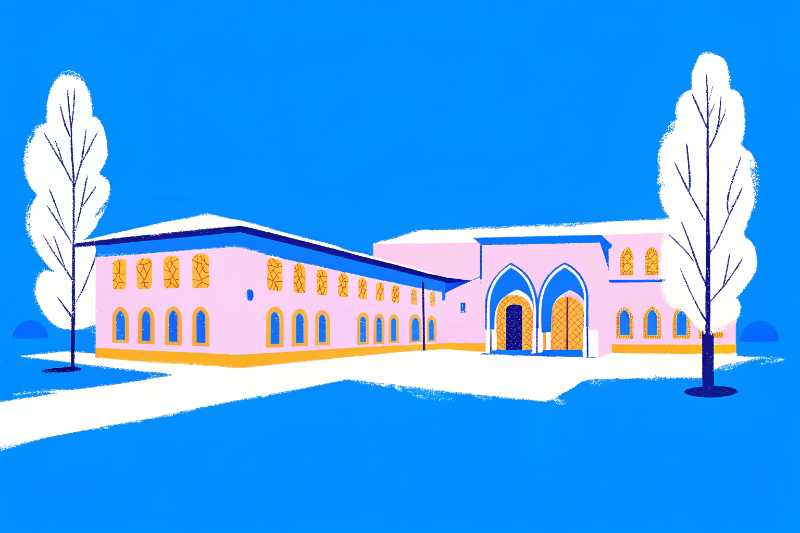
In 1896, the idea was born to open a secular school for Azerbaijani women, which was realized by the great son of the Azerbaijani people Haji ZeynalabdinTaghiyev.
Reformers like Taghiyev remarked on women's education among European women and Muslims of the Volga Tatars while postulating an egalitarian and progressive interpretation of the Koran. However, Russian colonizers, as in many other colonial contexts, were unconcerned about real emancipation of women and improvement in women's status.
Only Taghiyev’s willpower and the strength of character, at the same time his wisdom, reputation among the local Baku people and his material resources helped him to realize his ideas. In this way, Taghiyev could overcome local authorities’ displeasure and as well as resistance of orthodox part of the city with very smooth diplomatic maneuvers. So that, in his letter to the controller of Caucasus Education Center, K.P.Yankovsky dated 24 April 1986, he declares that the foundation of school is dedicated to Tsar Nikolay II accession to the throne: “I decided to celebrate the coronation ceremony of Imperator in Baku with the establishment of Russian-Muslim school with my own expense.” At the same time, the school was named after Empress Alexandra Fedorovna, “Aleksandrinskaya” by Taghiyev. As a result of this diplomatic approach, the permission to open the first school for Muslim women was received from authorities.
Taghiyev faced opposition not only from government circles but also from his countrymen. Numerous facts show with what difficulty Taghiyev had to convince his compatriots of the need to educate girls. “Teach your daughters. In the future they will be mothers and they will be able to raise their children. What children can you expect from an ignorant mother?” he appealed to the people.
On 7 October 1901 at noon, the grand opening of the Empress Alexandra Fedorovna Baku women’s Russian-Muslim school was held. The newspaper “Kaspi” described the event as follows: "The seventh day of October will be memorable for our Muslims as a day that marked the real implementation of the idea of women’s education, which has long been nurtured by the best part of the Muslim society of the Transcaucasia, and not only Transcaucasia, but all regions of Russia with a Muslim population, for whom the issue of women’s education is one of the pressing questions of life. This alone makes today’s celebration in Baku an all-Muslim event to which to all Russian Muslims must respond".
Taghiyev announced at the ceremony the idea which was his dream for a long time: “Today’s celebration is just the beginning of an extensive plan. You can see the top floor of the building: it was built by me this way in order to make it easier to build another floor on it. I will do this as this school should turn into a women’s school for Muslim girls. It’s now my dream.”
Picture 1.
The Board of Trustees, teachers and students of school. 1901.
The school accepted Muslim girls older than 7 years (subsequently–8 years). Originally it was planned to accept 50 pupils of whom 20 poor Muslim girls studied and lived in the school hostel with the sponsorship of Taghiyev and 30 at their own expense.
However, the number of those wishing to enter for free education was higher. Despite the lack of vacancies, the Board of Trustees decided to accept another 13 poor girls at the request of Taghiyev. By the time when the college opened, the number of students receiving free education had risen to 35, while the total number of entrants was 58.
The Alexandra Russian-Muslim women’s school was a boarding school. Any access by men was banned. Students were totally provided with uniforms, food and manuals by Taghiyev. The Azerbaijani and Russian language (language and literature), arithmetic, history, geography, nature- study, calligraphy, singing, music, ethics, anatomy, medicine and religion were taught in the school. Along with general subjects, the school conducted workshops on handicrafts and housekeeping. The school had all conditions for the long stay of students, including a hospital, kitchen, laundry, shower rooms and sanitary services. It had a special physician and nurse staff, and the health of the boarders was under regular supervision.
In addition to spacious, bright classrooms, cozy bedrooms and dining rooms, Tagiyev’s school had a great stage on which the works of Azerbaijani classics were produced. In general, it should be noted that special attention was paid to the aesthetic education of girls in the school. They were regularly taken to performances at Taghiyev’s theatre and to the cinema, and the school had a choir and literary and dance circles.
Picture 2.
Classroom
The press of those years and high-ranking representatives of the tsarist administration, who were closely familiar with the school, highly valued the educational process here. Indeed, the school was a genuine specimen of secular education for women, skillfully combining Muslim traditions with European modernism. Of course, the primary credit for this belongs to the founder and trustee of the college – Haji ZeynalabdinTaghiyev. But, he could not carry this burden alone. Taghiyev collected the best intellectuals of Baku and progressive religious figures. Through the newspaper Taghiyev requested to show their support for the first Muslim school from all Muslim women teachers. As a director of the school, he appointed the spouse of one of the first intellectuals of the country and the founder of first newspaper (“Akinchi”) which was published in Azerbaijan, Hasanbay Malikov. His spouse, Hanifa khanum was the first intellectually developed and educated Azerbaijani woman.
Among the teachers of this school were different educated and enlightener women, such as Mina Talishinskaya (the first enlightener of Azerbaijan), Rahila Terequlova (a prominent teacher), Maryam Sulikevich, Adila Shahtaxtinskaya, Gulbahar Ahriyeva, Maryam Hembitskaya(women–enlighteners), Shafiga Afandizadeh (the first Azerbaijani publicist–writer), Mina Aslanova (honored teacher of Azerbaijan), Govhar Qaziyeva, Nabat Narimanova, Shahrabani Shabanova (women–activists), Sakina Akhundzadeh (the first Azerbaijani woman–playwright), Khadija Agayeva (a talented teacher–later she was awarded with an order of Lenin) and many others.
These women were capable of transmitting Taghiyev's ideas of enlightenment. It is these ideas that will be of key importance for ensuring sustainable development and a civilized future for today's independent Azerbaijan.
Taghiyev’s close associate was his spouse Sona khanum– deputy chairperson of the Board of Trustees. Later, along with Haji, she was an honorary trustee of the school. In1915, she became one of the founders and chairperson of the society to assist poor students of the Alexandra Russian-Muslim women’s school.
Picture 3.
Needlework lesson, 1901
In 1915 the two years pedagogical courses for the girls were opened on the basis of school. Salima Yagubova, who graduated from High Pedagogical course named after Bestujev in Sankt-Petersburg, was appointed as a director for these courses and the education program of the courses was accepted with her attendance. She taught methodology, pedagogics and psychology at the courses. The first graduation of pedagogical courses was in 1917 and the girls who finished these courses played a very important role in the development process of enlightenment and educational activities, as well as in decreasing the ignorance as much as possible in Azerbaijan.
The social and political events of the early 20th century affected the work of the women’s school. In connection with the beginning of World War I, there appeared difficulties with the arrival of non-resident students and delivery of food. On 2 May1917, the Board of Trustees decided to close the school from September 1917.
Opening the first secular Muslim woman school in Baku in 1901 by Taghiyev caused the revival and initiative in the society. The tendency was followed and a lot of new schools were opened in other cities and remote places of the country very soon. The new schools were established in Yerevan, Tbilisi, Ganja, Shamakhi, Guba, Gazakh and other cities and in most cases the directors of these schools were the alumnis of Taghiyev’s school. Even some of them opened schools in their houses.
The Taghiyev`s school proved to be a vivid example of transforming the black gold of oil into the human gold of an educated woman. The years passed and women’s education became common in the Eastern world, coeducation of boys and girls appeared, and educated women became actively involved in public life, along with men.
References
Abbasov, Ali.Gender müntəxabatı. Baku: Adiloğlu, 2004.
Amirbekova, Raida. “Развитие женского образования в Азербайджане в начале 20 века”. Publishing house Education and Sciences.r.o. n.d. Web. 25 Jul. 2015.
Azerbaijan Gender Information Center Site. n.p. Azerbaijani women in the period of enlightenment and revolutions of XIX - XX centuries.n.d. Web. 20 Jul. 2015.
Jabbarov, Farhad. “First secular school for women in the Muslim East.”IRS: International Azerbaijani Magazine(2006): n. pag. Web. 10 Jul. 2015.
Ganjali, Sabir. Women, beauty and sanctity. Baku: “Azərbaycan”, 2001
Mikayilova, Ulviya. “Women in Azerbaijan”.Collaboratory for Digital Discourse and Culture @ Virginia Tech. n.d. Web. 30 Jul. 2015.
Published
Downloads
How to Cite
License
Copyright (c) 2025 Malahat SAMADOVA

This work is licensed under a Creative Commons Attribution 4.0 International License.


 Republic of Uzbekistan, Tashkent city,
  +998 93 097 75 88