Semantic differences between enantiosemy and antonymy in English and Uzbek
DOI:
https://doi.org/10.5281/zenodo.20807842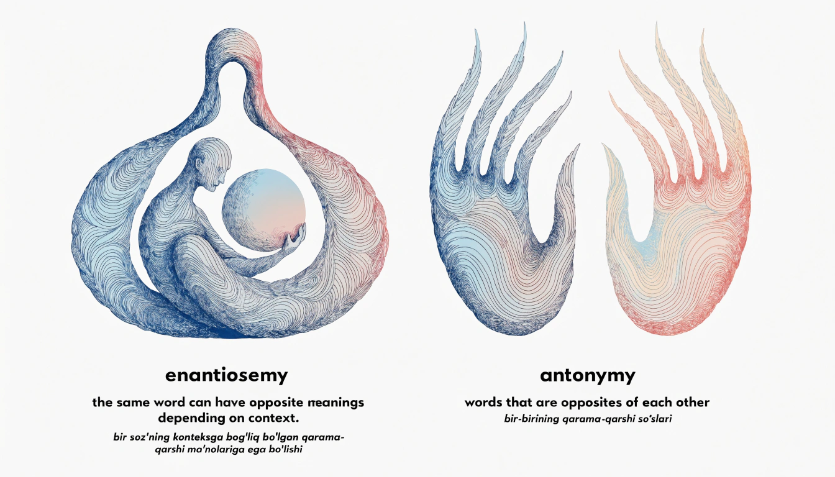
Abstract
This article examines a question that is often oversimplified in descriptive semantics: Are enantiosemy and antonymy two variants of the same opposition, or do they represent different mechanisms of semantic organization? The research material consists, on the one hand, of canonical antonymic pairs in English and Uzbek, and on the other, of a purposefully selected comparative set of enantiosemic units from English and Uzbek sources. Methodologically, the study combines comparative-semantic analysis, contextual analysis, elements of a corpus-oriented approach, and descriptive quantification. The focus is not only on dictionary definitions but also on how opposing meanings are distributed across contexts, syntactic frames, and evaluative speech modes. The study shows that antonymy constitutes an interlexical, largely binary, and typically decontextualizable opposition, whereas enantiosemy is localized within a single form, depends much more heavily on context, and often exhibits asymmetry between opposing meanings. For English material, the most characteristic examples are lexically fixed terms such as sanction, oversight, dust, seed, clip, graduate, and solicitor; for the Uzbek material-not only lexical, but also grammatical, phraseological, and subjective-evaluative realizations, for example, toʻychi, tushmoq, chiqmoq, olmoq, yuz burmoq, as well as the literary usages of ofat and qiyomat. On this basis, it is demonstrated that enantiosemy cannot be reduced to either “internal antonymy” or ordinary polysemy: it is a special type of sign-internal opposition situated at the intersection of lexical semantics, pragmatics, and the historical development of meaning.
Keywords:
Enantiosemy antonymy semantic opposition polysemy contextual analysis corpus approach English Uzbek comparative linguisticsReferences
Jones, S. (2002). Antonymy: A corpus-based perspective. Routledge.
Jones, S., Murphy, M. L., Paradis, C., & Willners, C. (2012). Antonyms in English: Construals, constructions and canonicity. Cambridge University Press.
Kajberuny, H., & Hakobyan, T. (2020). Different approaches to enantiosemy in English. Armenian Folia Anglistika, 16(1), 51–65.
Klegr, A. (2013). The limits of polysemy: Enantiosemy. Linguistica Pragensia, 23(2), 7–23.
Murphy, M. L., Paradis, C., Willners, C., & Jones, S. (2009). Discourse functions of antonymy: A cross-linguistic investigation of Swedish and English. Journal of Pragmatics, 41(11), 2159–2184.
Narbayeva, X. A. (2024). Enantiosemiya mavzusini o‘rganishda badiiy asarlar bilan ishlash. In conference proceedings O‘zbek tilshunosligi va adabiyotshunosligi taraqqiyoti, xalqaro hamkorlik masalalari (pp. 463–464).
Odilov, Y. R. (2015a). Enantiosemic features of the words in the Uzbek language. Türk Dünyası Dil ve Edebiyat Dergisi, 40, 173–181.
Odilov, Y. R. (2015b). Grammatical enantiosemy in the Uzbek language. International Journal on Studies in English Language and Literature, 3(11), 1–5.
Odilov, Y. R. (2016). Theoretical basis of enantiosemy and its occurrence in speech. Anglisticum, 5(5), 102–108.
Romanchuk, Ju. V. (2020). Enantiosemy in the English language. Russian Linguistic Bulletin, 3(23), 25–28.
Published
Downloads
How to Cite
Issue
Section
License
Copyright (c) 2026 Sarvar Boborajab ugli Hafizov

This work is licensed under a Creative Commons Attribution 4.0 International License.


 Republic of Uzbekistan, Tashkent city,
  +998 93 097 75 88