Semantic and Linguocultural Features of Proverbs in the Korean and Uzbek Languages: A Comparative Analysis
DOI:
https://doi.org/10.5281/zenodo.22299054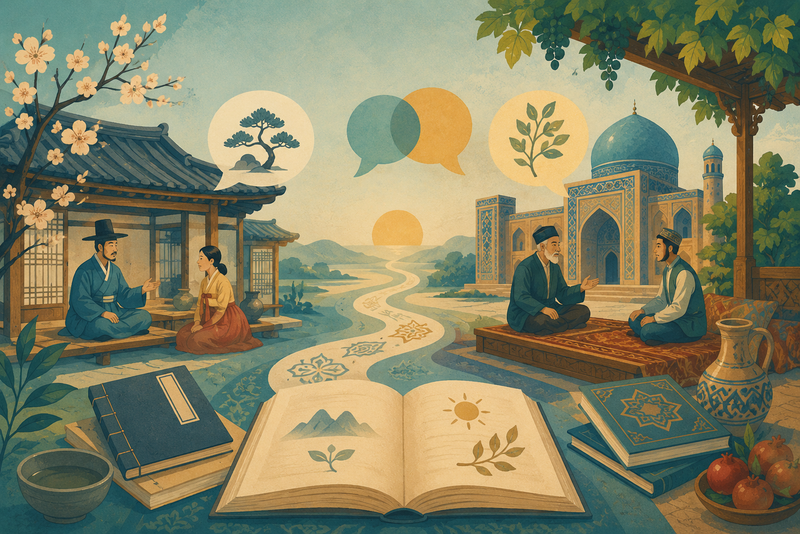
Abstract
This article provides a comparative analysis of the semantic and linguocultural features of selected Korean proverbs and their meaningful counterparts in Uzbek. The study focuses on the following Korean proverbs: 가재는 게 편, 가지 많은 나무에 바람 잘 날 없다, 같은 값이면 다홍치마, 개구리 올챙이 적 생각 못한다, 고래 싸움에 새우 등 터진다. The research employs semantic, comparative, and linguocultural analysis methods. It examines the lexical composition of the proverbs, their literal and figurative meanings, imagery, and the national and cultural concepts expressed through these linguistic units. Particular attention is given to comparing the images used in Korean and Uzbek to express identical or similar life situations and identifying their common and distinctive features. The findings demonstrate that Korean and Uzbek proverbs share common semantic meanings related to human experience, moral values, and social relationships. However, the ways in which these meanings are expressed are closely connected with the national worldview, historical experience, lifestyle, and cultural characteristics of each nation. The results also highlight the linguocultural and communicative value of using proverbs in Korean language teaching.
Keywords:
Korean language Uzbek language proverb 속담 paremiology semantics linguoculture comparative analysis national worldviewReferences
Bayonkhanova, I., & Xvang, S. D. (2026). Koreys va o‘zbek xalq maqollarida odob me’yorlari va axloqiy qadriyatlarning mantiqiy-pragmatik talqini. Koreys va o‘zbek xalq maqollarida odob me’yorlari va axloqiy qadriyatlarning mantiqiy-pragmatik talqini. 23-27. Samarqand: Samarqand davlat chet tillar instituti.
Maftunaxon, S. (2023). Chorva nomlari asosida shakllangan o‘zbek xalq maqollarining lingvopoetik va uslubiy xususiyatlari.
Mirzayev, T., Musoqulov, A., & Sarimsoqov, B. (2005). O‘zbek xalq maqollari. Toshkent: Sharq.
국립국어원. (б.д.). 표준국어대사전. 서울: 국립국어원.
국립국어원. (б.д.). 표준국어대사전. 국립국어원.
최권진. (2007). 속담으로 배우는 한국어 2. 서울: 한국문화사.
Published
Downloads
How to Cite
Issue
Section
License
Copyright (c) 2026 Abdulaziz Bekmirza ugli Kholmirzayev

This work is licensed under a Creative Commons Attribution 4.0 International License.


 Republic of Uzbekistan, Tashkent city,
  +998 93 097 75 88