Cognitive triad model of linguistic performance: theoretical foundations and structural components
DOI:
https://doi.org/10.5281/zenodo.21718944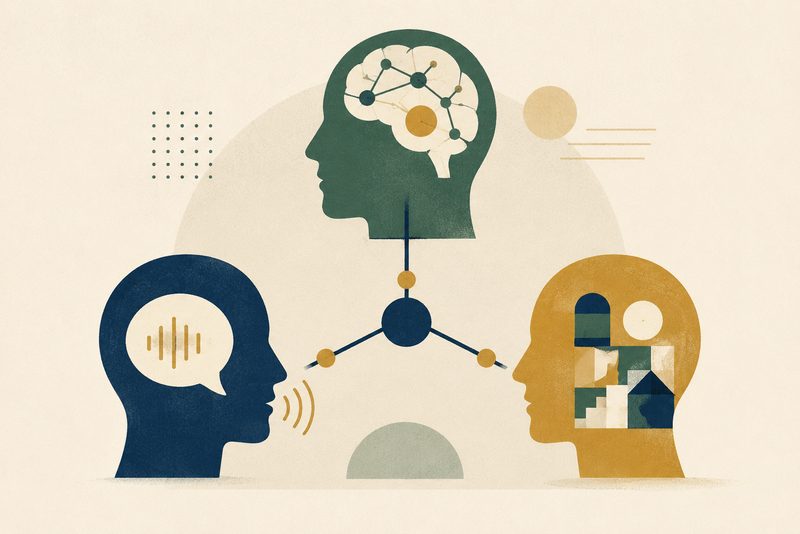
Abstract
This article examines the interrelation of linguistic performance with psychocognitive, neurobiological, and cultural-historical factors from the perspective of cognitive linguistics. The main goal of the study is to propose a cognitive triad model that allows us to interpret human linguistic performance as a single system and to elucidate its theoretical foundations. The study used an interdisciplinary approach, conceptual analysis, comparative analysis, and cognitive modeling methods. The article analyzes linguistic, psycholinguistic, neurolinguistic, and cultural approaches to linguistic performance, and identifies their scientific possibilities and existing limits. As a result, a cognitive triad model based on the integration of psychocognitive processes, neurobiological mechanisms of brain activity, and cultural experience in humans is proposed. This model allows us to explain the processes of human perception, processing, conceptualization, storage, and expression through speech as a holistic, systematic mechanism. The research results reveal the complex nature of linguistic performance and serve as basis for further research in cognitive linguistics, psycholinguistics, neurolinguistics, linguodidactics, artificial intelligence and natural language processing.
Keywords:
Linguistic performance cognitive linguistics cognitive model psychocognitive processes neurolinguistics cultural scripts language and thought cognitive triad conceptualization natural language processingReferences
Saussure, F. de. (1959). Course in general linguistics (W. Baskin, Trans.). Philosophical Library. (Original work published 1916), 9-33.
Черниговская, Т. В. (2006). Зеркальный мозг, концепты и язык: Цена антропогенеза. Физиологический журнал им. И. М. Сеченова, 92(1), 84-90.
Черниговская, Т. В. (2013). Чеширская улыбка кота Шрёдингера: Язык и сознание. Языки славянской культуры, 145-150.
Clark, E. V. (2003). First language acquisition. Cambridge University Press, 6.
Friederici, A. D. (2012). The cortical language circuit: From auditory perception to sentence comprehension. Trends in Cognitive Sciences, 16(5), 262-268.
Wernicke, C. (1874). Der aphasische Symptomencomplex: Eine psychologische Studie auf anatomischer Basis. Cohn & Weigert, 9-23.
Sapir, E., & Whorf, B. L. (1956). Language, thought, and reality: Selected writings of Benjamin Lee Whorf. MIT Press, 1-22.
Vygotsky, L. S. (1978). Mind in society: The development of higher psychological processes. Harvard University Press, 23-30, 56-90.
Wierzbicka, A. (1997). Understanding cultures through their key words: English, Russian, Polish, German, and Japanese. Oxford University Press, 23-26.
Broca, P. (1861). Remarques sur le siège de la faculté du langage articulé, suivies d’une observation d’aphémie (Perte de la parole). Bulletins de la Société Anatomique de Paris, 36, 330-357.
Van Dongen, H. R. (1988). Clinical aspects of acquired aphasia and dysarthria in childhood. University Hospital Rotterdam-Dijkzigt, 4-5.
Piaget, J., & Inhelder, B. (1969). The psychology of the child (H. Weaver, Trans.). Basic Books. (Original work published 1966), 151.
Chomsky, N. (1965). Aspects of the theory of syntax. MIT Press, 4.
Published
Downloads
How to Cite
Issue
Section
License
Copyright (c) 2026 Billura Ravshanovna Tolipova, Yulduz Ravshanovna Parpiyeva

This work is licensed under a Creative Commons Attribution 4.0 International License.


 Republic of Uzbekistan, Tashkent city,
  +998 93 097 75 88