Lexico-morphological means of expressing emotivity: emotive lexis, affixation, intensifiers, and interjections
DOI:
https://doi.org/10.5281/zenodo.21719859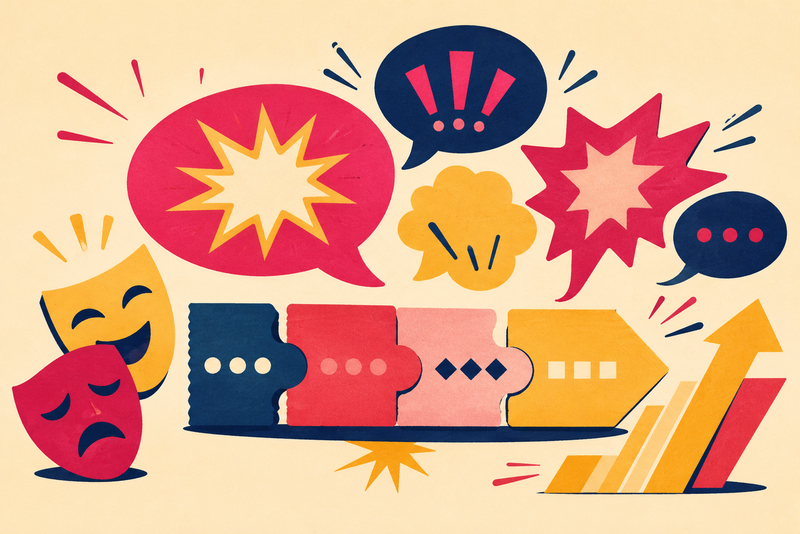
Abstract
This article examines how emotivity − the linguistic encoding of a speaker’s subjective emotional stance − is realized through four lexico-morphological resources of English: emotive lexis, affixation, intensifiers, and interjections. Rather than treating these devices separately, the study integrates them into one analytical frame, tracing how each contributes a distinct, complementary layer to affective expression in discourse. Using a qualitative-integrative design, it synthesizes empirical findings from corpus-based, pragmatic, and typological studies published mainly between 2020 and 2025, supplemented by illustrative material drawn from the primary sources. Results show that emotive lexis operates through the connotation-denotation split and evaluative vocabulary in confrontational or affiliative discourse; affixation, especially diminutive and augmentative morphology, encodes graded stances from endearment to contempt; intensifiers show no uniform semantic “wear-out” displaying register-sensitive productivity instead; and interjections occupy a structurally central, not marginal, role in interaction, with language-specific, phonosemantically shaped inventories. Emotivity thus emerges as a layered system combining lexical, derivational, and interactional resources rather than isolated devices.
Keywords:
Emotivity emotive lexis affixation diminutives intensifiers interjections connotation corpus linguisticsReferences
Andrason, A., Harvey, A., & Griscom, R. (2023). The form of emotions: The phonetics and morphology of interjections in Hadza. Poznań Studies in Contemporary Linguistics, 59(2), 289–316.
Andrason, A., & Karani, M. (2023). Emotive interjections in Maasai (Arusa). Italian Journal of Linguistics, 35(2), 75–118.
Bally, C. (1909). Traité de stylistique française [Treatise on French stylistics]. Klincksieck.
Bayakhmetova, A. A., & Omarova, Z. K. (2021). Multi-aspect of the use of diminutives in the texts of art works. Bulletin of Toraighyrov University. Philology Series, (2), 27–36. https://doi.org/10.48081/HEQK5677
Biedermann, R. (1969). Die deutschen Gradadverbien [Unpublished doctoral dissertation]. University of Heidelberg.
Corpus linguistics and social media. (2025). In Encyclopedia of applied linguistics / Elsevier reference collection. Elsevier.
Dingemanse, M. (2024). Interjections at the heart of language. Annual Review of Linguistics, 10, 257–277. https://doi.org/10.1146/annurev-linguistics-031422-124743
Dinata, I. K. A., Jayantini, I. G. A. S. R., & Juniartha, I. W. (2023). English interjections and their translation in the subtitles of My Little Pony movie. Journal of Language and Applied Linguistics, 4(2), 235–243. https://doi.org/10.22334/traverse.v4i2.89
Manova, S., Grestenberger, L., & Korecky-Kröll, K. (Eds.). (2023). Diminutives across languages, theoretical frameworks and linguistic domains (Trends in Linguistics: Studies and Monographs, Vol. 380). De Gruyter Mouton.
Mohammad, S. M. (2020). Sentiment analysis: Automatically detecting valence, emotions, and other affectual states from text (arXiv:2005.11882). arXiv. https://arxiv.org/abs/2005.11882
Nikitin, M., Kirillov, A., & Krivosheeva, E. (2022). Using emotive-evaluative vocabulary to express conflict situations on Twitter. Eurasian Journal of Applied Linguistics, 8(2), 199–207.
Schmidt, J. (2022). Do intensifiers lose their expressive force over time? A corpus linguistic study. In R. Gergel, I. Reich, & A. Speyer (Eds.), Particles in German, English, and beyond (Studies in Language Companion Series, Vol. 224, pp. 69–94). John Benjamins. https://doi.org/10.1075/slcs.224.03sch
Shakhovsky, V. I. (2008). Lingvisticheskaya teoriya emotsiy [Linguistic theory of emotions]. Gnozis.
Tueller, I. (2023). The meaning and productivity of English diminutive affixes. Schwa: Language and Linguistics, 20, 1–14.
Published
Downloads
How to Cite
Issue
Section
License
Copyright (c) 2026 Rivanna Abdullaevna Khabipova

This work is licensed under a Creative Commons Attribution 4.0 International License.


 Republic of Uzbekistan, Tashkent city,
  +998 93 097 75 88